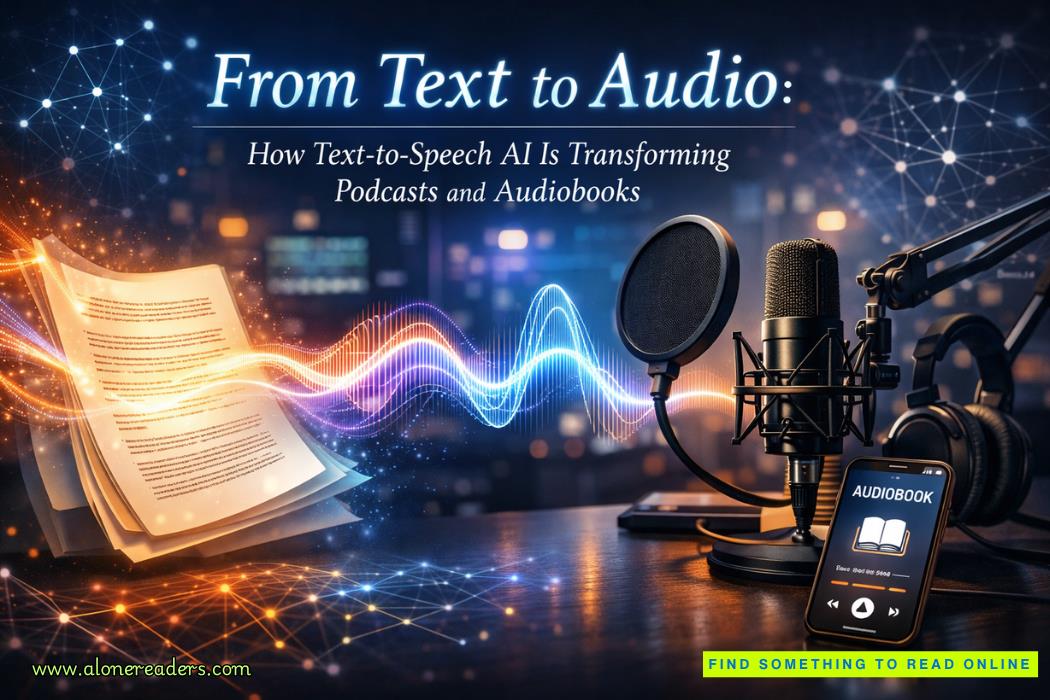
From Text to Audio: How Text-to-Speech AI Is Transforming Podcasts and Audiobooks
- Last updated: February 25, 2026
How Text-to-Speech AI Is Transforming Podcasts and Audiobooks
- The Technical Evolution of Text-to-Speech Systems
- Text-to-Speech in Podcast Production
- The Reinvention of Audiobook Production
- Democratizing Access to Audio Publishing
- Multilingual Expansion at Scale
- Ethical and Creative Tensions
- Hybrid Models: Human + AI Collaboration
- Economic Implications for the Audio Industry
- Creative Experimentation and New Formats
- Listener Experience and Market Response
- The Future Trajectory
The audio industry is undergoing a structural transformation driven by one powerful capability: high-fidelity neural text-to-speech (TTS). What began as robotic screen readers has evolved into emotionally expressive, near-human synthetic voices capable of narrating long-form content with remarkable clarity and nuance. Today, TTS is not merely a convenience feature; it is reshaping the economics, accessibility, scalability, and creative possibilities of podcasts and audiobooks.
This shift is not theoretical. It is operational. Independent podcasters, digital publishers, ed-tech platforms, and even major media houses are integrating AI voice synthesis directly into their production pipelines. The result is faster publishing cycles, multilingual expansion at scale, and new hybrid storytelling formats that were previously cost-prohibitive.
Below is a deep analysis of how text-to-speech AI is transforming both podcasts and audiobooks—technically, economically, and culturally.
The Technical Evolution of Text-to-Speech Systems
From concatenative synthesis to neural voice modeling
Early TTS systems relied on concatenative methods—stitching together pre-recorded phonemes. These systems lacked fluidity and emotional depth. Modern systems, however, use deep neural networks trained on massive speech datasets, enabling them to model prosody, intonation, pacing, and contextual emphasis.
Neural TTS systems now generate speech using end-to-end architectures that predict waveforms directly or synthesize mel-spectrograms refined by neural vocoders. The output is significantly more natural because:
- Prosody is context-aware rather than rule-based.
- Pacing adapts dynamically to punctuation and semantic weight.
- Emotional tone can be adjusted via conditioning parameters.
- Voice timbre can be cloned or customized using speaker embeddings.
This technical maturity is what allows TTS to enter long-form content domains such as podcasts and audiobooks—areas where unnatural cadence would immediately break immersion.
Text-to-Speech in Podcast Production
Reducing production bottlenecks
Traditional podcast production involves scripting, recording sessions, voice editing, retakes, audio cleanup, mastering, and publishing. For solo creators or small teams, this process is time-intensive and operationally expensive.
AI voice synthesis changes the workflow:
- Write or generate script.
- Select AI voice profile.
- Adjust pacing and emphasis.
- Export studio-quality audio.
- Add music and publish.
Production cycles shrink dramatically. Daily podcasts become viable without daily studio sessions.
Enabling script-first content strategies
Text-to-speech shifts podcasting toward a script-driven model. This benefits creators who are stronger writers than performers. It also allows tighter narrative control, especially in investigative, educational, or analytical formats where precise wording matters.
For content ecosystems that already operate text platforms—such as blogs, knowledge portals, or review sites—this opens an immediate expansion path. Existing articles can be converted into audio versions with minimal incremental cost.
Voice branding and synthetic hosts
Modern TTS systems allow persistent voice identities. A podcast can maintain a consistent “host” voice without scheduling conflicts, fatigue, or geographic constraints.
Synthetic hosts offer:
- Unlimited availability.
- Perfect consistency in tone.
- Scalability across multiple shows.
- The ability to localize the same host voice into multiple languages.
This does not eliminate human hosts, but it introduces a parallel model: voice as a programmable asset.
The Reinvention of Audiobook Production
Cost compression in long-form narration
Traditional audiobook production is expensive. Professional narrators, studio time, audio engineers, and post-production work significantly raise costs. For independent authors, this can be prohibitive.
AI narration reduces the marginal cost of audiobook creation. Once a manuscript is finalized:
- Voice selection takes minutes.
- Full-length books can be generated in hours.
- Revisions are easy—edit the text and regenerate specific sections.
This enables backlist monetization. Authors can convert older titles into audio formats that were previously financially unjustifiable.
Customization of listening experiences
Neural TTS allows dynamic customization:
- Adjustable speaking speed without distortion.
- Multiple voice options per character.
- Genre-appropriate tone adjustments.
- Gender or accent preferences.
For fiction, different characters can be assigned distinct synthetic voices. For non-fiction, pacing can be optimized for clarity and comprehension.
This personalization layer moves audiobooks closer to adaptive media rather than static recordings.
Democratizing Access to Audio Publishing
Lower barriers for independent creators
The most profound impact of TTS AI is democratization. Historically, professional-grade audio required capital investment. Now, a creator with strong writing skills can launch a polished audio product without studio infrastructure.
This expands participation in:
- Educational podcasting.
- Niche research summaries.
- Technical explainers.
- Serialized fiction.
- News digests.
In global markets, particularly outside major media hubs, this shift is transformative.
Accessibility and inclusion
Text-to-speech enhances accessibility in ways beyond commercial production. It enables:
- Instant audio versions of written articles.
- Support for visually impaired audiences.
- Easier consumption for neurodivergent users.
- Multilingual accessibility for global readers.
For publishers, integrating AI narration into digital platforms increases engagement time and broadens audience reach.
Multilingual Expansion at Scale
Localization without re-recording
One of the strongest advantages of AI voice systems is cross-language scalability. A podcast episode written in English can be translated and synthesized into Spanish, Arabic, French, or Mandarin with consistent tone and structure.
Instead of hiring multiple narrators in multiple regions, publishers can:
- Translate script.
- Select localized synthetic voice.
- Maintain brand consistency across markets.
This dramatically lowers the cost of international expansion.
Global podcast networks powered by AI
AI-generated multilingual feeds can transform local podcasts into global channels. Educational and knowledge platforms, especially, benefit from this model.
It becomes feasible to operate a multi-language podcast network without maintaining distributed recording teams worldwide.
Ethical and Creative Tensions
Authenticity vs efficiency
Audio media has traditionally been intimate. Listeners form parasocial bonds with hosts and narrators. Synthetic voices introduce questions:
- Does authenticity diminish if narration is AI-generated?
- Should disclosure be mandatory?
- How do listeners emotionally respond to non-human hosts?
Audience perception varies. In informational or educational content, clarity and consistency often outweigh concerns about authenticity. In narrative fiction or personality-driven podcasts, emotional nuance remains critical.
Voice cloning and consent
Advanced TTS systems can replicate real voices from short samples. This raises serious concerns:
- Unauthorized voice replication.
- Deepfake narration.
- Intellectual property disputes.
- Performer compensation models.
The industry is moving toward clearer voice licensing frameworks, but regulation is still evolving.
Hybrid Models: Human + AI Collaboration
AI as co-producer, not replacement
Rather than replacing human narrators, many workflows integrate AI strategically:
- AI drafts narration; human narrator refines emotional scenes.
- AI produces interim versions for editorial review.
- AI voices used for minor characters.
- Human hosts record intros and conclusions; AI handles main script.
This hybrid approach combines efficiency with emotional authenticity.
Editorial agility
AI narration allows rapid iteration. If a script requires updating—such as correcting data in a news episode—audio can be regenerated immediately. Traditional recordings would require re-booking studio time.
For news, research, and technology podcasts, this agility is invaluable.
Economic Implications for the Audio Industry
Shift from labor-intensive to compute-intensive production
The cost center moves from studio time to computational infrastructure. This favors scalable platforms and SaaS-based voice services.
Key implications:
- Lower entry barriers increase competition.
- Content volume grows significantly.
- Discovery becomes more important than production capacity.
- Monetization models shift toward distribution and audience engagement.
Subscription and content bundling opportunities
Platforms can bundle written and audio formats seamlessly. For example:
- Blog subscription includes auto-generated audio versions.
- Book purchases include instant audiobook.
- Premium podcast tiers offer multilingual feeds.
AI makes these bundles economically viable.
Creative Experimentation and New Formats
Dynamic audio generation
Text-to-speech AI enables new content formats:
- Personalized news briefings generated daily.
- On-demand summaries of long articles.
- Adaptive learning modules with AI narration.
- Choose-your-path fiction where branches are synthesized in real time.
This moves audio beyond static publishing into interactive audio ecosystems.
Serialized and high-frequency publishing
Because production friction is low, creators can publish more frequently. Serialized content becomes easier to maintain without burnout.
For fiction writers and analytical bloggers, this creates recurring engagement cycles.
Listener Experience and Market Response
Improved quality expectations
As neural voices become indistinguishable from human narration in many contexts, listener tolerance for poor audio decreases. Even small creators can achieve broadcast-level clarity.
Content abundance and attention scarcity
The main bottleneck is no longer production—it is attention. As more AI-generated audio enters the market, curation, brand trust, and distribution strategies become decisive.
Creators must focus on:
- Unique perspectives.
- High-quality writing.
- Consistent publishing cadence.
- Strong platform positioning.
Technology alone is not a differentiator; content depth remains essential.
The Future Trajectory
Text-to-speech AI will likely become embedded infrastructure rather than a visible novelty. Within a few years:
- Most digital articles may include instant audio playback.
- Audiobook creation could become default for self-publishing.
- Podcast networks may operate AI-assisted production pipelines.
- Voice personalization could become user-controlled.
The long-term trajectory suggests audio as a parallel default format to text, not a secondary adaptation.
Conclusion
Text-to-speech AI is not merely improving audio production; it is redefining it. By lowering costs, accelerating workflows, enabling multilingual distribution, and unlocking new creative models, neural voice synthesis is transforming podcasts and audiobooks from niche extensions into scalable digital ecosystems.
For writers, publishers, educators, and independent creators, the opportunity is significant. The competitive advantage now lies not in access to a recording studio, but in the quality of ideas and the strategic deployment of AI-powered audio tools.
The transition from text to audio is no longer optional. It is becoming a standard expectation in modern content delivery—and text-to-speech AI is the engine driving that shift.