AI Personal Assistants vs. Human Assistants: What Busy Professionals Prefer in 2026
- Last updated: February 25, 2026
AI Personal Assistants vs. Human Assistants
- The Rise of AI Personal Assistants in Executive Workflows
- The Enduring Strength of Human Assistants
- Cost Structures in 2026
- Productivity Impact: Automation vs. Delegation
- Privacy, Confidentiality, and Risk
- Hybrid Models: The Dominant Choice in 2026
- What Solo Professionals Prefer
- What Corporate Executives Prefer
- Decision Fatigue and Cognitive Relief
- Strategic Control vs. Operational Efficiency
- The Future Trajectory
- Final Assessment: What Busy Professionals Actually Prefer in 2026
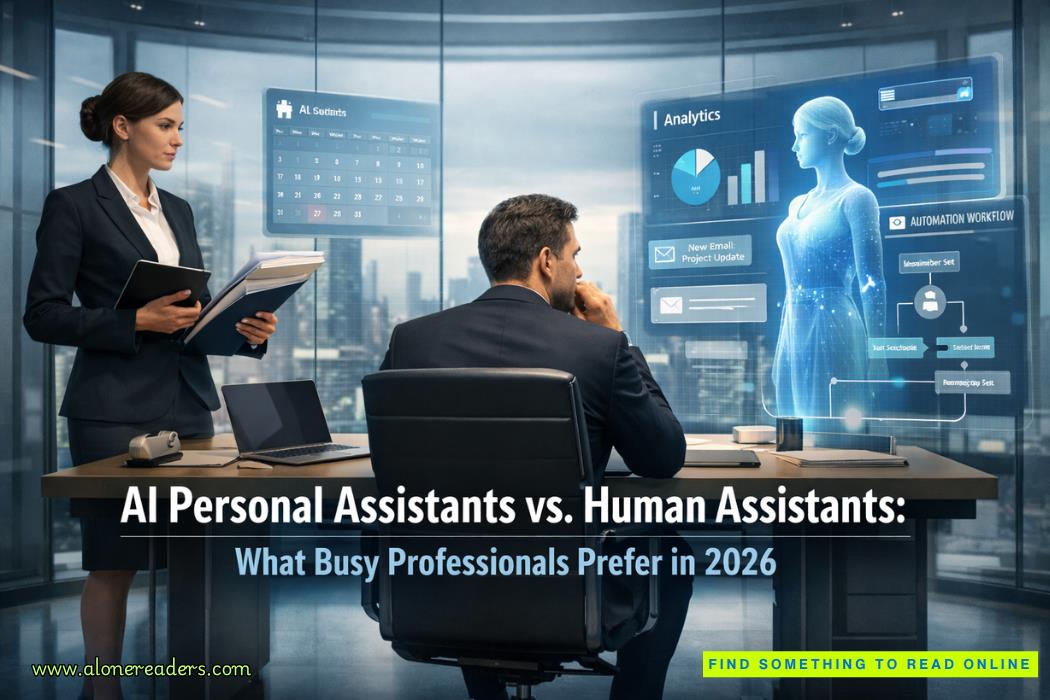
In 2026, the assistant role has undergone one of the most profound transformations in modern professional history. What was once exclusively a human function—calendar management, travel coordination, executive filtering, and operational follow-through—has evolved into a hybrid ecosystem where artificial intelligence systems compete directly with skilled human professionals.
The question for busy executives is no longer whether AI can assist. It is whether AI can replace, complement, or outperform a human assistant in high-pressure, decision-intensive environments.
The answer is not simplistic. It depends on task type, organizational maturity, risk tolerance, and leadership style.
Below is a detailed breakdown of what professionals are actually choosing in 2026—and why.
The Rise of AI Personal Assistants in Executive Workflows
From simple chatbots to executive copilots
The AI assistants of 2026 are fundamentally different from the rule-based digital assistants of a decade ago. They now integrate deeply with enterprise systems: CRM platforms, ERP software, accounting systems, HR portals, legal documentation repositories, and internal communication tools.
Modern AI assistants can:
- Draft and refine complex emails in executive tone.
- Summarize multi-hour board meetings in seconds.
- Schedule meetings across global time zones automatically.
- Prepare briefing documents before calls.
- Monitor KPIs and alert leaders to anomalies.
- Generate structured reports and presentation outlines.
For data-heavy executives—founders, CTOs, analysts, investors—AI assistants are no longer optional tools. They are cognitive accelerators.
Speed and scale advantage
AI operates continuously. There is no fatigue curve. No sick leave. No timezone constraint. For professionals managing distributed teams across continents, AI provides immediate responsiveness that human assistants simply cannot match at scale.
For example:
- Real-time inbox triage during a 12-hour flight.
- Automated investor update generation every quarter.
- Dynamic calendar rescheduling when meetings run over.
The time savings are measurable. Many executives report reclaiming 8–12 hours per week through AI workflow automation alone.
The Enduring Strength of Human Assistants
Despite AI’s rapid evolution, human assistants remain deeply valued—especially in high-trust environments.
Emotional intelligence and situational awareness
AI can parse language patterns, but it cannot fully interpret nuanced interpersonal dynamics. A seasoned human assistant understands:
- Which client needs extra reassurance.
- When a CEO is overwhelmed and should decline non-critical meetings.
- How to read tone in subtle internal conflicts.
- The political undercurrents of board-level interactions.
In 2026, high-level executives still rely on human assistants for relational filtering. The ability to protect an executive’s time while preserving relationships is not purely algorithmic.
Judgment in ambiguity
AI performs optimally with structured data. But ambiguous, sensitive, or reputationally risky decisions require human discretion.
Consider:
- Managing a potential PR crisis.
- Handling confidential personnel issues.
- Navigating negotiations.
- Interpreting unspoken expectations from stakeholders.
A human assistant can act as a strategic gatekeeper—something AI cannot fully replicate because it lacks lived experience and accountability.
Cost Structures in 2026
AI Assistant Cost Model
AI subscriptions typically operate under:
- Monthly SaaS pricing tiers.
- Per-seat enterprise licenses.
- Usage-based API consumption fees.
For a growing startup or solo professional, AI assistants cost a fraction of a full-time salary. Even enterprise-grade systems remain significantly cheaper than a highly skilled executive assistant.
Additionally:
- No recruitment cost.
- No payroll tax.
- No training ramp-up period.
- No turnover risk.
Human Assistant Cost Model
A skilled executive assistant in 2026 commands a competitive salary, particularly in major business hubs. Beyond base salary, organizations incur:
- Superannuation or retirement contributions.
- Benefits.
- Paid leave.
- Onboarding and HR overhead.
- Workspace and equipment costs.
However, cost alone is not the deciding factor. For C-level leaders managing billion-dollar decisions, the value of discretion and human judgment outweighs salary expense.
Productivity Impact: Automation vs. Delegation
Automation advantage
AI assistants excel at:
- Repetitive tasks.
- Data summarization.
- Document generation.
- Scheduling optimization.
- Workflow orchestration.
The productivity gains come from eliminating micro-decisions. Instead of asking a human assistant to research 10 flight options, an AI system can evaluate price, loyalty status, travel time, and executive preference instantly.
Delegation advantage
Human assistants shine when delegation requires strategic context. For example:
- Preparing a board meeting narrative.
- Coordinating across departments.
- Handling VIP travel where contingencies matter.
- Managing sensitive calendar conflicts.
Delegation builds shared understanding. Over time, a human assistant becomes an extension of executive thinking. AI does not “learn loyalty” or long-term executive psychology in the same way.
Privacy, Confidentiality, and Risk
One of the most critical debates in 2026 concerns data security.
AI risks
AI assistants integrate deeply with email, documents, and internal knowledge bases. This introduces:
- Data exposure risks.
- Model training leakage concerns.
- Regulatory compliance challenges.
- Vendor lock-in vulnerabilities.
Highly regulated industries—law, finance, healthcare—remain cautious about full AI delegation.
Human risks
Humans introduce a different risk profile:
- Insider threats.
- Emotional conflicts.
- Potential breaches due to negligence.
However, contractual frameworks and professional norms provide accountability structures that AI systems do not inherently possess.
For many executives, risk mitigation strategies now involve hybrid workflows: AI handles operational tasks; humans oversee sensitive communications.
Hybrid Models: The Dominant Choice in 2026
The most common executive setup in 2026 is neither purely AI nor purely human.
It is hybrid.
AI handles:
- Inbox prioritization.
- Meeting summarization.
- Draft document preparation.
- Data monitoring.
- Routine scheduling.
Human assistants handle:
- Stakeholder communication.
- Strategic filtering.
- Reputation-sensitive decisions.
- Travel exception management.
- High-level coordination.
This layered approach maximizes efficiency while maintaining human oversight where nuance matters.
What Solo Professionals Prefer
Entrepreneurs, consultants, and independent creators increasingly prefer AI-first models.
Reasons include:
- Lower cost.
- Immediate deployment.
- Scalability.
- Full control over workflow automation.
For solo operators managing digital businesses, AI assistants effectively function as fractional operational staff.
In 2026, many independent professionals operate without hiring any human administrative support at all.
What Corporate Executives Prefer
Corporate leaders show a different pattern.
C-suite executives often maintain:
- One senior human executive assistant.
- Multiple AI workflow integrations.
Why?
Because corporate environments are politically complex. Managing board members, investors, media relationships, and internal leaders requires a trusted human intermediary.
In such environments, AI is a force multiplier—not a replacement.
Decision Fatigue and Cognitive Relief
One overlooked factor in this debate is cognitive energy.
AI reduces:
- Email clutter.
- Scheduling friction.
- Research time.
- Drafting workload.
But humans reduce:
- Social friction.
- Emotional burden.
- Relationship management strain.
Executives who experience burnout often value human assistants for psychological support and situational buffering. AI reduces workload, but humans reduce stress in interpersonal domains.
Strategic Control vs. Operational Efficiency
In 2026, the assistant decision often reflects leadership philosophy.
Executives who prioritize:
- Systems thinking.
- Automation.
- Data-driven workflows.
Lean toward AI-heavy solutions.
Executives who prioritize:
- Relationship leverage.
- Political intelligence.
- Cultural navigation.
Lean toward human-heavy models.
The distinction is less about capability and more about executive identity.
The Future Trajectory
AI assistants are becoming more autonomous, context-aware, and integrated. However, the more powerful they become, the more executives demand governance frameworks.
Expect:
- AI audit logs for decision traceability.
- Ethical oversight layers.
- Customizable data silos.
- AI sandboxing for confidential operations.
Human assistants, meanwhile, are upskilling. Many now operate as operations managers, chief-of-staff hybrids, or workflow architects—leveraging AI instead of competing with it.
The assistant role is evolving upward, not disappearing.
Final Assessment: What Busy Professionals Actually Prefer in 2026
The data from corporate behavior patterns suggests:
- Solo professionals overwhelmingly prefer AI-first.
- Growing startups prefer AI with occasional human outsourcing.
- Established executives prefer hybrid.
- High-stakes leadership environments retain human assistants as strategic gatekeepers.
The most efficient structure in 2026 is not “AI vs. human.” It is AI plus human—with clearly defined responsibility boundaries.
AI excels at speed, scale, and structured logic.
Humans excel at judgment, discretion, and relational intelligence.
Busy professionals do not choose between them based on hype. They choose based on risk profile, operational complexity, and leadership style.
In the end, the assistant—whether artificial or human—is not about convenience.
It is about leverage.
And in 2026, leverage is no longer singular. It is layered.