AI Video Generators in 2026: How Creators Are Replacing Traditional Editing
- Last updated: February 25, 2026
AI Video Generators in 2026
- The Shift from Timeline Editing to Prompt-Based Production
- AI Scene Generation: Eliminating the Need for Raw Footage
- AI Avatars and Synthetic Presenters
- Intelligent Editing: AI as a Post-Production Supervisor
- The Collapse of the Technical Barrier to Entry
- Workflow Compression: From Weeks to Hours
- Hybrid Creators: AI-Assisted, Not Fully Automated
- AI Voice Synthesis and Sound Design Automation
- Personalized Video at Scale
- Ethical and Creative Concerns
- Economic Impact on the Creator Industry
- The Psychological Shift: Creation Without Friction
- The Future: Beyond 2026
For more than two decades, video production followed a predictable workflow: scripting, filming, importing footage, cutting clips, color grading, sound mixing, captioning, exporting. The process required specialized software, expensive hardware, and highly trained editors. In 2026, that linear workflow is being fundamentally rewritten.
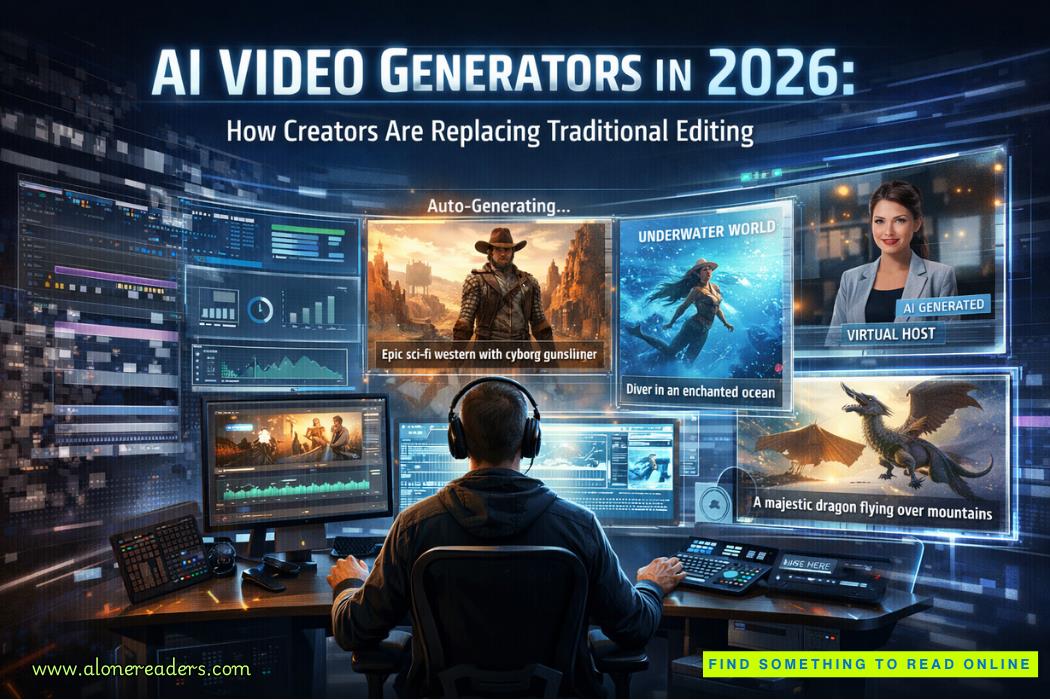
AI video generators are no longer experimental tools for hobbyists. They have evolved into production-grade systems capable of replacing large portions of traditional post-production. What began as simple text-to-video experiments has matured into fully integrated creation ecosystems that generate scenes, animate avatars, compose music, synthesize voiceovers, add captions, optimize pacing, and even localize content across multiple languages — all within minutes.
The result is not just faster editing. It is a structural transformation of how content is conceived, produced, and distributed.
The Shift from Timeline Editing to Prompt-Based Production
From Clip Arrangement to Instructional Creation
Traditional editing software revolves around timelines. Editors manually trim clips, stack audio tracks, insert transitions, and adjust keyframes. AI video generators in 2026 invert that model. Instead of arranging media manually, creators provide structured prompts or scripts.
A creator might input:
- Script text
- Target audience persona
- Desired tone (educational, cinematic, humorous)
- Platform format (YouTube long-form, TikTok vertical, Instagram Reel)
- Branding guidelines
The AI system then constructs the video automatically: selecting visuals, generating b-roll, animating text overlays, inserting transitions, matching music to pacing, and outputting optimized versions for multiple platforms.
The timeline still exists — but increasingly as a refinement tool rather than the core engine of creation.
AI Scene Generation: Eliminating the Need for Raw Footage
Synthetic Visuals Replacing Physical Filming
In 2026, creators no longer need to film every shot. AI video generators produce photorealistic or stylized scenes directly from scripts. This includes:
- Office environments
- Urban landscapes
- Futuristic settings
- Product demonstrations
- Explainer animations
- Historical recreations
The implications are massive for solo creators and small teams. Instead of hiring videographers, renting locations, and managing lighting setups, a single creator can generate high-quality visuals from a laptop.
For educational channels, corporate training departments, and marketing teams, this has drastically reduced production budgets while increasing output frequency.
AI Avatars and Synthetic Presenters
Replacing On-Camera Performance
A major turning point in 2026 has been the normalization of AI presenters. Synthetic avatars can:
- Mimic natural facial expressions
- Maintain eye contact
- Adjust tone dynamically
- Speak multiple languages with native accents
- Sync lip movements accurately
Creators who prefer not to appear on camera now deploy branded AI hosts. Companies use consistent virtual spokespersons across marketing, onboarding, and product tutorials.
This is not merely convenience — it is scalability. One script can be instantly rendered into:
- English (US, UK, Australian accents)
- Spanish (Latin American, European variants)
- French, German, Japanese, Arabic
- Region-specific dialects
Localization that once required separate filming sessions is now automated.
Intelligent Editing: AI as a Post-Production Supervisor
Automated Pacing, Retention Optimization, and Hook Engineering
Modern AI video systems analyze viewer behavior data and optimize videos accordingly. Instead of relying solely on creative instinct, creators now leverage AI-driven analytics embedded into editing workflows.
AI tools automatically:
- Shorten slow segments
- Insert pattern interrupts at predicted drop-off points
- Enhance hook intensity within the first 5–8 seconds
- Adjust subtitle timing for better engagement
- Add dynamic zooms to maintain visual stimulation
Retention engineering, once an advanced skill reserved for experienced YouTubers, is now algorithmically embedded in the editing process.
The result is not only faster production — but higher-performing content.
The Collapse of the Technical Barrier to Entry
Democratization of Video Production
In previous years, professional editing required:
- Mastery of complex software
- Understanding codecs and rendering settings
- Knowledge of color grading techniques
- Audio mixing competence
- Caption formatting expertise
AI video generators abstract these technical layers. The system handles:
- Aspect ratio optimization
- Color correction
- Audio leveling
- Background noise removal
- Subtitle styling
- Export encoding
This democratization has significantly lowered the barrier to entry for creators worldwide. Entrepreneurs, educators, consultants, and small business owners now produce professional-grade video without hiring agencies.
Workflow Compression: From Weeks to Hours
Production Timelines Shrinking Dramatically
In 2026, a marketing campaign that once required:
- 1 week scripting
- 2–3 days filming
- 1 week editing
- 2 days revisions
Can now be completed within a single day using AI systems.
Creators generate draft versions instantly, iterate via prompt adjustments, and deploy final outputs within hours. For fast-moving industries — such as news commentary, finance updates, product launches, and trending topics — this speed advantage is transformative.
Time-to-publish is now a competitive advantage.
Hybrid Creators: AI-Assisted, Not Fully Automated
Why Traditional Editors Are Not Completely Gone
Despite the rapid adoption of AI video generators, traditional editing has not disappeared entirely. Instead, a hybrid model has emerged.
High-budget cinematic productions, feature films, and deeply stylized artistic projects still rely on human editors for nuanced storytelling, emotional pacing, and aesthetic decisions.
However, the majority of online content — tutorials, explainers, social media videos, corporate communications — is increasingly AI-assisted.
Professional editors are evolving into:
- Prompt engineers
- AI workflow designers
- Creative supervisors
- Style directors
Their expertise shifts from manual trimming to strategic creative oversight.
AI Voice Synthesis and Sound Design Automation
Replacing Voiceover Studios and Audio Engineers
In 2026, AI-generated voiceovers are nearly indistinguishable from human narration. These systems replicate:
- Emotional inflection
- Emphasis shifts
- Natural breathing patterns
- Conversational pacing
Sound design has also become automated. AI tools analyze video context and add:
- Ambient background noise
- Cinematic swells
- Subtle transition effects
- Emphasis stingers for key points
The once-separate audio engineering phase is now integrated into AI video pipelines.
Personalized Video at Scale
Dynamic Content Tailored to Individual Viewers
One of the most disruptive shifts is personalized video generation. AI systems can create variations of a single video tailored to different audience segments.
For example:
- Different intros based on viewer demographics
- Region-specific product offers
- Personalized names in corporate onboarding videos
- Adaptive call-to-action placements
Marketing departments are now generating thousands of unique video versions programmatically — something that would have been impossible with traditional editing methods.
Ethical and Creative Concerns
Authenticity, Deepfakes, and Oversaturation
The rapid replacement of traditional editing raises legitimate concerns:
- Deepfake misuse
- Loss of human craftsmanship
- Oversaturation of AI-generated content
- Viewer fatigue
As AI video tools become accessible to everyone, content volume has exploded. The competitive advantage now lies not merely in production quality, but in originality, storytelling depth, and strategic positioning.
Creators who rely purely on automation without creative differentiation struggle to stand out.
Economic Impact on the Creator Industry
Cost Structures and Revenue Models Changing
The economics of video production have shifted dramatically:
- Freelance editing demand has declined in lower-tier markets
- Agencies have reduced production staff
- Subscription-based AI tools have replaced hourly editing contracts
- Solo creators operate with output levels once reserved for full teams
At the same time, new roles have emerged:
- AI workflow consultants
- Prompt optimization specialists
- Automation integration engineers
- Synthetic avatar brand designers
The creator economy has not shrunk — it has reorganized.
The Psychological Shift: Creation Without Friction
Lower Creative Resistance
Traditional editing often created psychological resistance due to time intensity and technical complexity. AI video generators remove much of that friction.
Creators can now experiment rapidly:
- Generate multiple creative directions
- Test alternate scripts
- Compare pacing variations
- Launch A/B video tests quickly
The speed of iteration encourages creative exploration.
However, it also introduces a risk: the temptation to publish without refinement.
The Future: Beyond 2026
The trajectory suggests deeper integration between AI systems and distribution platforms. Future developments may include:
- Direct publishing from AI generators into social platforms
- Automatic thumbnail and title optimization
- Real-time content adjustment based on live viewer engagement
- Fully interactive AI-generated narrative videos
Traditional editing software will likely persist — but increasingly as specialized tools for high-end or artistic production rather than everyday creator workflows.
Conclusion: Replacement or Reinvention?
AI video generators in 2026 are not merely tools; they represent a paradigm shift in digital content production. They have replaced large segments of manual editing, compressed production cycles, lowered barriers to entry, and redefined creative workflows.
Yet this transformation is not about eliminating human creativity. It is about relocating it.
Editing is no longer primarily about cutting clips on a timeline. It is about designing systems, crafting intelligent prompts, shaping narratives strategically, and leveraging automation effectively.
Creators who understand this shift — who combine AI efficiency with authentic storytelling — are not just replacing traditional editing. They are redefining what video creation means in the modern digital economy.
The tools have changed. The opportunity has expanded. The question is no longer whether AI will replace traditional editing — but how creators will use it to build the next era of digital media.